
Build Your Own Butcher Block Standing Desk Top for Half the Price
Brand-name solid wood tops run $400–$700. A better-looking butcher block from a home center runs $120–$250 and takes one weekend.
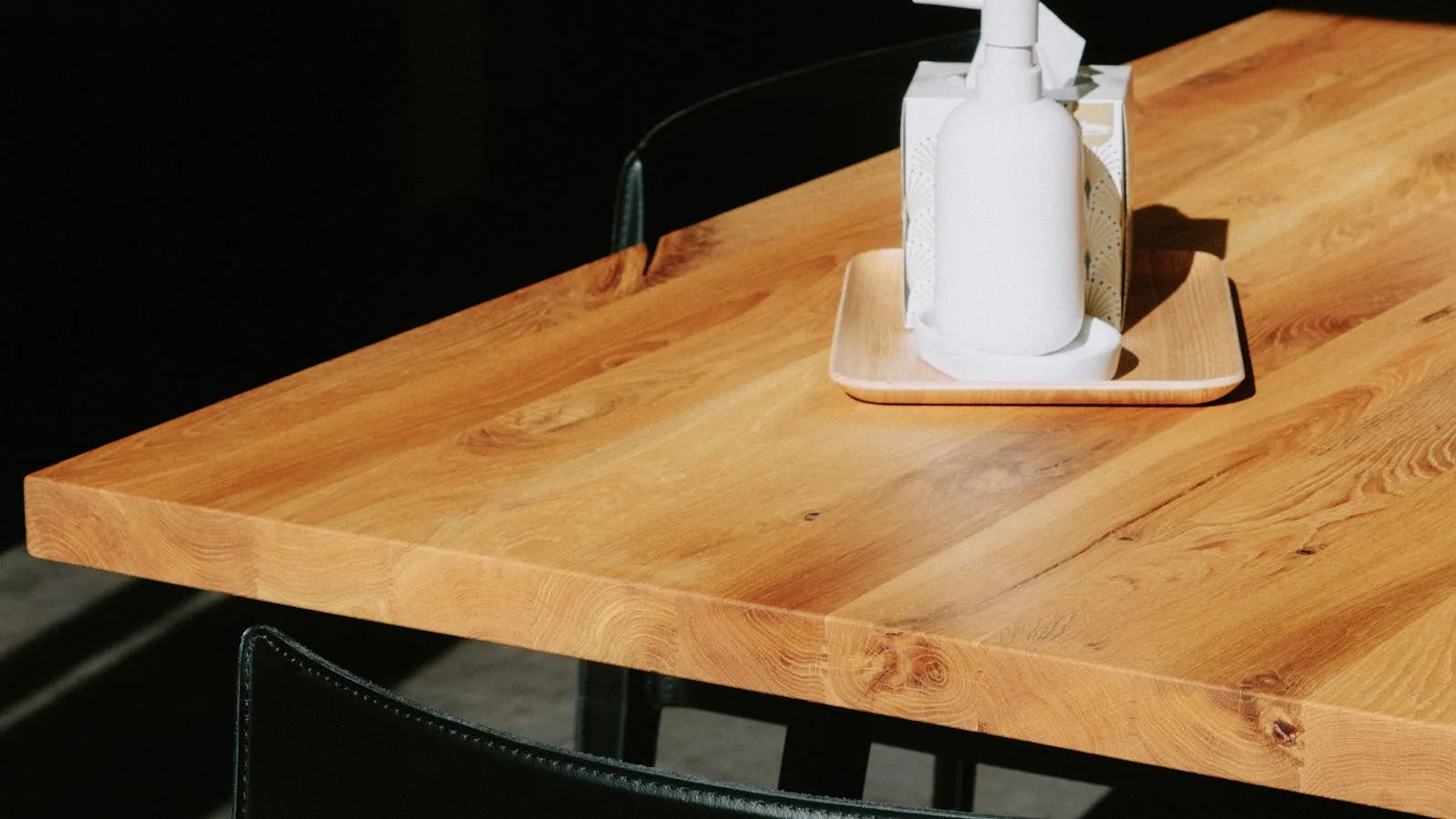
The frame of a standing desk is what makes it adjustable. The top is what you actually look at and touch. Premium brands charge a steep markup on solid wood tops — $400 to $700 over a laminate top of the same size — and most of that markup is for a piece of glued-up hardwood that Home Depot and Lumber Liquidators sell off-the-shelf for a fraction of the price. The labor between "raw butcher block" and "finished standing desk top" is real, but it's a weekend, not a craft. If you have a frame already, or you're buying one without a top, this is the highest-leverage upgrade in the whole setup.
Why a butcher block beats most factory tops
"Butcher block" is industry shorthand for a panel of hardwood strips glued edge-to-edge into a single thick slab — the same construction used in kitchen countertops and prep tables. Three things make it well-suited for a desk:
- It's real solid wood. Most factory standing-desk tops are MDF or particleboard with a thin laminate or veneer layer. They look fine for two years. The edges chip when you bump them with a chair. Coffee rings sink through the veneer. Butcher block ages instead of degrading.
- It's thick. 1.5 inches is standard, 1.75 inches is common. That mass damps vibration in a way a 1-inch MDF top simply can't — the same standing-desk frame is noticeably less wobbly under a butcher block than under the laminate top it shipped with. Wobble at standing height is the spec that matters most; a heavy top is a free upgrade to it.
- It's flat and pre-finished enough to use as-is. Unlike a slab of raw lumber, butcher block ships already glued up, planed, and surface-sanded. You're finishing it, not building it.
What to buy
The main decision is wood species and source. The practical options:
- Hard maple butcher block. The default. Pale, hard, durable, takes any finish. Home Depot and Lowes both stock the Hampton Bay / Hardwood Reflections brand in 50×25 and 74×39 sizes for $200–$350. IKEA's Karlby (birch or oak veneer over particleboard, not true butcher block — read the spec) is cheaper but not actually solid; their Skogsta line is real wood. Lumber Liquidators and local hardwood dealers will cut to size and run a wider species selection.
- Acacia. Significantly darker, more grain variation, popular in mid-century-modern setups. Slightly softer than maple but plenty hard for desk use. Often $50–$100 less than maple at home centers.
- Walnut. The premium pick. $400–$600 for a desk-sized piece. Dark, rich, and the species that looks closest to a $700 Uplift solid-wood top. Worth it if you're going to keep this desk a decade.
- Birch or rubberwood. Cheapest, lightest, paler than maple. Acceptable but you'll feel the cost saving in the heft.
Size: most home-center butcher blocks come in 50×25 or 74×39. The 50-inch size pairs with a single-monitor setup; 74-inch fits dual monitors with room. Depth matters more than people think; 25 inches is the absolute minimum and 28+ is better — go with the 39-inch-deep block if you can afford the real estate, then crosscut it to your target depth.
The weekend build
Tools needed: an orbital sander (rentable for $20/day if you don't own one), a few grits of sandpaper (120, 180, 220), a drill, and whatever finish you pick. That's it. No tablesaw, no jointer, no planer. The block ships flat.
- Cut to size if needed. A circular saw with a clamped straightedge handles a crosscut cleanly. If the home-center size already works for you, skip this.
- Sand the surface and edges. Start at 120 grit if the surface feels rough, otherwise 180. Finish at 220. Go with the grain. Sanding the edges over to a soft 1/16" radius dramatically reduces how often your forearms remember the edge exists.
- Finish. The two reasonable choices: an oil-and-wax blend (Odie's Oil, Tried & True, raw tung oil with beeswax topcoat) for a soft natural look, or a hard wipe-on polyurethane (Minwax Polycrylic, General Finishes Arm-R-Seal) for a more protective film finish. Two to three coats either way, light sand with 320 between coats. Plan a day for the finish to cure before you put weight on it.
- Drill the frame mounting holes from underneath. Center the top on the frame upside down, mark each frame hole with a pencil, drill pilot holes that are 1/3 the diameter of your mounting screws and 1/4 inch shallower than the wood thickness so you don't blow through. Use the screws that came with the frame.
- Flip and mount. Done.
The math
A 60×30 hard-maple butcher block at Home Depot is about $250. Sandpaper, finish, and miscellaneous: $40. Total: $290 for a solid-wood top that out-performs and out-looks the laminate top your $400 frame shipped with, and competes directly with the $600 solid-wood upgrade most brands charge for at the same size. The frame can be any quality two-leg or four-leg base — the top doesn't care whether your frame is a $300 Flexispot or a $700 Uplift.
The Ergodriven team wrote up their own version of this build a while back with photos of the finish process; their writeup is worth a read if you want a more visual walk-through.
What can go wrong
- Cupping or warping over time. Solid wood moves with humidity. Finish all sides and edges, not just the top, so moisture exchanges evenly. If you skip the underside finish you can get a slight bow within a year.
- Buying veneered MDF by accident. A "butcher block" that's 3/4 inch thick and conspicuously light is engineered wood with a hardwood veneer. Real butcher block is 1.5+ inches thick and noticeably heavy. Read the SKU.
- Over-sanding the edges. A small chamfer is comfortable. A big roundover starts looking like a coffee table from 1998. Stop earlier than you think.
Bottom line
You can have a real-wood standing desk top, in the species and size you want, for around $300 and a weekend. The frame is the engineering. The top is the finish work, and the finish work is a lot easier than the brands selling you a "premium" top would like you to believe. If you already own a frame, a butcher block upgrade is the cheapest path to a desk that looks and feels like the $1,000 option without paying for it.
