
The Walking Pad Question
It's the junk food of walking. That can still be useful.
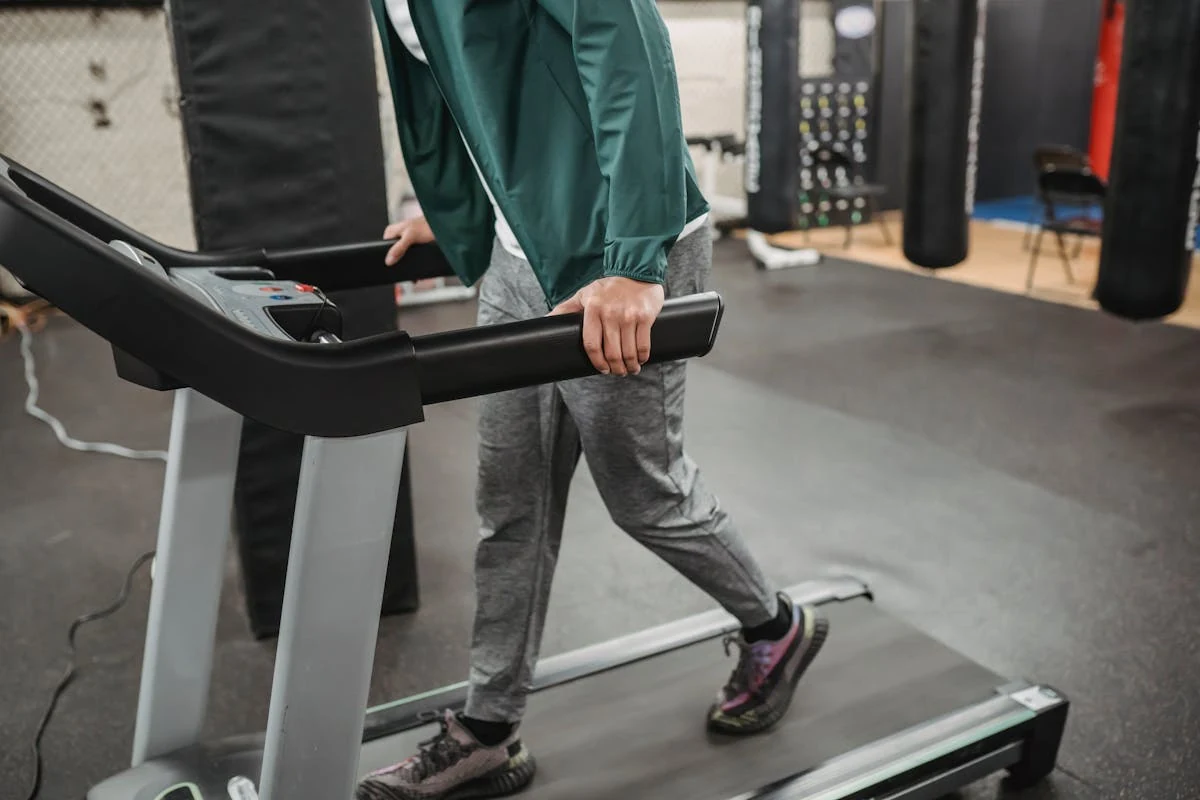
Walking pads — flat folding under-desk treadmills — got popular fast. The promise is direct: walk while you work, exercise while sitting (sorry, standing) at your desk. Calorie burn, cardiovascular benefit, less stillness. The accessory practically sells itself.
It's also not what the research actually supports as a wholesale solution. Walking pads have a place. The place is smaller and weirder than the marketing implies, and there's a real argument — best made by Katy Bowman and adapted by Ergodriven — that treadmill walking is the junk food of walking. Empty calories. Better than nothing, not the real thing.
Why "junk food walking"
Real walking happens over varied terrain. Even a flat sidewalk has subtle slope, surface texture, slight obstacles, micro-decisions about where to put your foot. Your body uses dozens of stabilizing muscles (foot intrinsics, lateral calf, glute medius, hip rotators) to navigate that landscape, and the loading is constantly shifting. The walk varies you.
On a flat moving belt, the terrain is fixed. Your stride takes the same length, the same angle, the same impact, every time. The stabilizers don't fire. The posterior chain doesn't engage the way it does when you're actually pushing yourself across the ground (on a treadmill the ground is being pushed past you — different mechanics). You're walking on autopilot, and your body is being trained, repetition by repetition, to walk in the autopilot pattern.
The downstream consequence: regular treadmill walking subtly reshapes your gait. Less posterior chain engagement. Smaller stride. Heel-strike compensation patterns that don't serve you when you actually go outside. People who do all of their walking on treadmills don't walk as well outside; the patterns transfer.
The cognitive cost
Walking takes brain. Even at slow speeds, your motor cortex is doing real work to coordinate the locomotion. Lab studies of treadmill-desk users find a measurable hit to cognitive performance during simultaneous walking and computer work — typically a 6–11% drop on fine-motor and arithmetic tasks compared to seated controls. That's not noise; it's a real productivity tax.
The Risk Management & Insurance program at Colorado State University doesn't recommend treadmill desks for this exact reason: walking represents cognitive load, and "this process must be stopped to free up mental resources for hard thinking."
So you're paying a productivity premium to do a watered-down version of walking that subtly degrades your gait over time. Stated that way, the value proposition is weaker.
So when is a walking pad useful?
Despite all of the above, walking pads do have legitimate use cases. The pattern: tasks where the cognitive cost of walking is low or zero, and where the alternative is sitting still anyway.
- Phone and video calls. Especially listen-mostly calls. The cognitive load is conversational, not fine-motor.
- Reading and reviewing. Documents, papers, long-form content where you're consuming, not producing.
- Email triage and routine messaging. Light typing, short responses, quick scrolling.
- Brief breaks between focused-work blocks. 10 minutes of slow walking between two 90-minute deep-work sessions can clear the head better than a sit-stand transition would.
What walking pads aren't for:
- Anything requiring fine-motor precision: typing-heavy work, mouse-precise tasks, design.
- Anything requiring deep focus: writing, code, complex analysis. The 6–11% cognitive hit shows up most here.
- Long durations. Past 30–40 minutes of continuous walking, gait gets sloppy, fatigue compounds, productivity drops further.
- Replacing real walks. Especially not this.
If you decide to buy one
Things that matter:
- Foldable form factor. The WalkingPad A1 Pro and similar fold flat for storage. If you can't put it away, you'll resent the floor space.
- Speed range that goes slow. Down to 0.5 mph, ideally. Anything faster than ~2 mph and you're no longer doing computer work; you're working out.
- Quiet operation. Under 65 dB or it's unusable on calls.
- Generous weight capacity (300+ lbs) — gives the motor headroom and extends pad lifespan.
- Real handlebar or none at all. Cheap walking pads have stubby handlebars that aren't actually useful for stability and just clutter the front of the desk. Either go full handlebar (commercial-style) or no handlebar.
The deeper move: outside
If walking pads are the junk food of walking, then real walks are the actual food. The 15-minute walk outside at lunch and the 15-minute walk after dinner together accomplish more for your spine, your hip mobility, your cardiovascular system, and your head than 90 minutes shuffling on a belt under a desk.
The walking pad is an under-desk version of "stop sitting still." It's a bridge to real walking, not a replacement. If you treat it as "I walk on the pad so I don't need to walk outside," you have it exactly backwards. If you treat it as "I walk on the pad during the half-hour calls I would otherwise sit through, AND I take real walks before lunch and after dinner," you're using both the right way.
Buy the walking pad if you actually have low-cognitive-load work to do on it. Skip it if you don't. Either way, get outside more.
